
What is expectancy in trading? Formula, examples and edge
Trading expectancy explained: the formula, worked examples, why it matters more than win rate, and how to use it to check your edge after fees.
Expectancy is the amount you make or lose, on average, every time you take a trade. It combines your win rate with the size of your average win and your average loss into one number, so it answers the question win rate can’t: does this way of trading actually make money?
Ask a trader how they’re doing and you’ll usually hear a win rate. “I’m hitting 70%.” It sounds great, and on its own it tells you almost nothing.
A 70% win rate with an average win of $50 and an average loss of $200 loses money. A 35% win rate with an average win of $300 and an average loss of $100 makes money. The number that captures both sides is expectancy.
This guide covers the expectancy formula, two worked examples, why it beats win rate, and what to do with the number once you have it.
Key takeaways
- Expectancy is your average profit or loss per trade, with wins and losses weighed together.
- The formula: (win rate × average win) − (loss rate × average loss).
- A high win rate can still lose money if your losses are much bigger than your wins.
- Measure it over enough trades - a month or a quarter, not twenty trades.
- Always use net figures. Fees can turn a small positive expectancy negative.
- Check it without outliers to see whether your edge is a process or a lucky day.
What is expectancy?
Expectancy is what you make, on average, every time you take a trade:
Expectancy = (win rate × average win) − (loss rate × average loss)
How to calculate expectancy: two worked examples
Take the two traders above:
- 70% win rate, $50 average win, $200 average loss: (0.70 × 50) − (0.30 × 200) = 35 − 60 = −$25 per trade.
- 35% win rate, $300 average win, $100 average loss: (0.35 × 300) − (0.65 × 100) = 105 − 65 = +$40 per trade.
| Trader A | Trader B | |
|---|---|---|
| Win rate | 70% | 35% |
| Average win | $50 | $300 |
| Average loss | $200 | $100 |
| Expectancy per trade | −$25 | +$40 |
The trader who is “right” twice as often is the one losing money. Expectancy makes that obvious in one number.
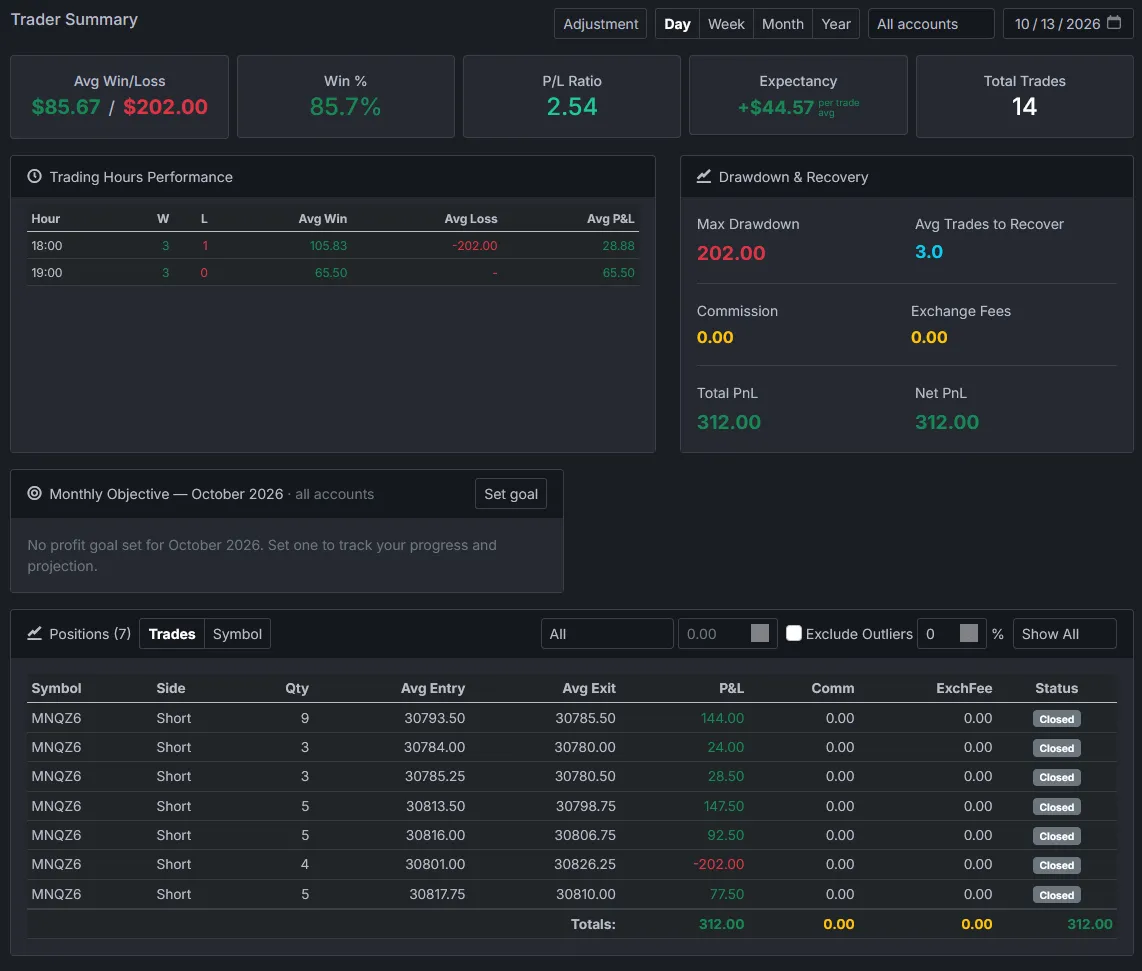
Expectancy next to win rate and average win and loss. Here the average loss is more than twice the average win, and the 85.7% win rate is what keeps expectancy positive.
Why expectancy matters more than win rate
Win rate and reward-to-risk pull against each other. Tighten your targets and your win rate goes up while your average win shrinks. Widen your stop and you’ll win more often but lose more when you’re wrong. Looking at either one alone, you can convince yourself you’re improving while your account says otherwise.
Expectancy settles the argument. If a change to your entries, stops or targets raises expectancy over a meaningful number of trades, it’s an improvement. If it doesn’t, it isn’t - whatever it did to your win rate.
To see where inside your trades a change shows up - early exits, winners that round-trip, stops that are wider than they need to be - look at MFE and MAE.
What to do with your expectancy: three steps
1. Check it’s positive over enough trades. Twenty trades is a story, not a statistic. Look at expectancy over a month or a quarter before drawing conclusions.
2. Check it after fees. Commissions and exchange fees are a fixed cost on every trade. A strategy with a small positive expectancy can turn negative once fees are counted, especially if you trade size or frequency. Always look at net figures.
3. Use it to set realistic goals. If your expectancy is $40 a trade and you take about 60 trades a month, a month around $2,400 is consistent with your edge. A goal of $10,000 isn’t a goal - it’s a hope, and chasing it is how traders overtrade. Working backwards from a goal also tells you what has to change: more trades at the same quality, or better expectancy per trade.
The catch: outliers
One huge winner can carry a month’s expectancy. That’s not necessarily bad, but you should know whether your edge comes from a repeatable process or from one lucky day. Recalculate expectancy with your biggest winners and losers trimmed out and see whether it holds - we wrote about that in Base hits or home runs?.
How Premo helps
Premo Trading calculates expectancy from every closed position, automatically, alongside win rate, average win and loss, P/L ratio, drawdown and net P&L after fees - for any day, week, month or year, any account and any symbol. Monthly objectives go one step further and show the expectancy you need for the rest of the month to reach your goal. See every statistic in Performance Analytics.
This article is educational and is not investment advice. Trading involves substantial risk of loss.
Frequently asked questions
What is expectancy in trading?
Expectancy is the amount you make or lose, on average, every time you take a trade. It combines how often you win with how big your wins and losses are: (win rate × average win) − (loss rate × average loss). A positive expectancy means your trades have made money on average; a negative one means they have lost it.
How do you calculate expectancy?
Multiply your win rate by your average win, multiply your loss rate by your average loss, and subtract the second number from the first. With a 35% win rate, a $300 average win and a $100 average loss: (0.35 × 300) − (0.65 × 100) = 105 − 65 = +$40 per trade.
Is a high win rate enough to be profitable?
No. A 70% win rate with an average win of $50 and an average loss of $200 has an expectancy of (0.70 × 50) − (0.30 × 200) = −$25 per trade. It loses money despite winning most of the time. Win rate only matters together with the size of your wins and losses.
How many trades do you need to measure expectancy?
More than a handful. Twenty trades is a story, not a statistic. Look at expectancy over a month or a quarter of trading before drawing conclusions about a strategy or a change to it.
Should expectancy include commissions and fees?
Yes. Commissions and exchange fees are a fixed cost on every trade, and a strategy with a small positive expectancy can turn negative once they are counted, especially at higher size or frequency. Always calculate expectancy on net P&L.
How do you use expectancy to set trading goals?
Multiply your expectancy by the number of trades you typically take. At $40 a trade and about 60 trades a month, a month around $2,400 is consistent with your edge. A goal far above that is a hope, not a plan - reaching it takes more trades at the same quality or a better expectancy per trade.
Can one big trade distort expectancy?
Yes. A single large winner can carry a month of expectancy. Recalculate it with your biggest winners and losers trimmed out to see whether your edge comes from a repeatable process or from one lucky day.